
Imagine a customer asks for a larger order, delivered a week earlier. Sales sees an opportunity. Production needs to check capacity. Purchasing needs to confirm materials. Before anyone can give an answer, several colleagues have to piece together information from different systems and spreadsheets.
The customer sees one delivery promise. Behind it sits a chain of decisions, handovers and responsibilities. As the business grows, that chain needs to hold together across more orders, more people and perhaps more locations.
Growth changes the requirements
Growth changes more than sales volumes. A new market may bring different customer requirements. A second production site adds planning dependencies. A larger team needs knowledge that once travelled naturally through conversations to become easier to share.
Working methods that served the business well can start to show their limits. Preparing for growth means understanding which ones need to evolve before they become a daily source of
“When manufacturing companies plan for growth, the conversation often starts with capacity, equipment and headcount. Just as important is understanding where critical knowledge still depends on individuals. As the organisation grows, that knowledge needs to be embedded in processes and systems so the business can scale without creating bottlenecks”, says Jessica Johansson, Sales at Navcite.
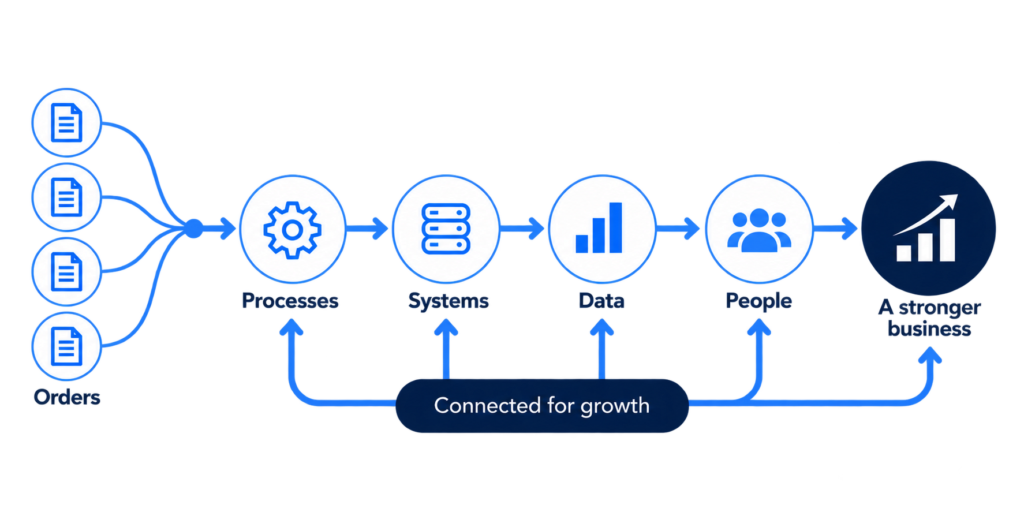
More business shouldn’t automatically mean more manual work
A spreadsheet fills a gap. An email keeps another department informed. An experienced colleague remembers which orders need an extra check. These workarounds often begin as sensible ways to keep things moving.
The difficulty comes when every additional order requires the same extra effort. More time goes into re-entering information, chasing updates and correcting discrepancies. The order may still ship, but the coordination behind it can eat into its margin.
Follow one order from enquiry to delivery with the people who handle it. Look for repeated entries, waiting time and approvals that no longer serve a clear purpose. Then decide what to simplify, what to standardise and what is worth automating.
“A growing business does not necessarily need a new ERP system. What it does need is clarity around what is causing the friction. In many cases, the biggest opportunities come from improving processes, working methods and adoption before replacing technology”, says Jessica Johansson.
More systems shouldn’t mean less control
Different parts of a manufacturing business need different tools. An ERP system supports core activities such as purchasing, inventory, production and finance, while other applications may support specialised needs.
The practical test is what happens when something changes. If a customer increases an order, planning needs the revised quantity and purchasing needs to understand the material requirements. Identifying a shortage while there is still time to act is more useful than discovering it when production is due to start.
Reliable integration involves more than moving data. It requires clear ownership, agreed rules and a way to handle exceptions. If an update fails, someone needs to know. Connecting the flow properly helps teams see the consequences of a change without calling around to reconstruct the picture.
More data should lead to better decisions
Knowing whether a larger order can be produced is only part of the decision. Will it require overtime, an urgent material purchase or changes to another production run? What will that mean for profitability and existing commitments?
Useful decision support brings the relevant information together around those questions. An order can look profitable until overtime, express freight and rework are taken into account. Seeing those cost drivers makes it easier to question the delivery plan or pricing before repeating the same pattern.
A shared view of capacity, delivery performance or margins also needs consistent definitions and clarity about how current the figures are. Start with a decision people struggle to make, then identify the information that would help them make it with greater confidence.
Technology should support the people doing the work
The people closest to a process can often identify obstacles that are easy to miss in a project plan. A status is difficult to find. A screen contains too much information. The next step is clear only to someone who has done the job for years.
For a planner, a useful workspace might show which orders need attention and why, without searching across several screens. For a new colleague, it might make the next step clear enough to complete a routine task without interrupting someone else.
Involving users early, testing with everyday tasks and providing relevant training help turn those needs into improvements that people can actually use.
“The most successful improvement initiatives usually start with a business problem, not a technology discussion. Identify a challenge that impacts daily operations, agree on what success looks like and focus on delivering measurable value before moving on to the next area”, says Jessica Johansson.
AI becomes more useful when the foundation is ready
AI offers another way to make information easier to use. One possible application is letting an employee ask a question in everyday language and receive a summary of relevant ERP information, instead of navigating several reports. Another is helping someone find the approved instruction for an unfamiliar task.
Whether an application is useful depends on the task, the available data and how the solution is implemented. Appropriate access, reliable source information and clear responsibility for checking results remain essential. Test against a practical outcome: can someone reach a dependable answer with less effort?
“The question is not whether AI should be part of your future. The question is where it can create practical value for your organisation today. Companies that start with a clear business objective tend to see results much faster than those that start with the technology itself”, says Jessica Johansson.
At Navcite, we look at how processes, systems and people work together — and how that relationship needs to develop as a business grows. The work continues after go-live: following up on what users need, checking whether improvements deliver the intended value and adapting support as requirements change.
Return to the customer asking for a larger order. The goal is not simply to say yes faster. It is to know what that promise requires: whether materials and capacity are available, what it means for other commitments and whether the order makes business sense.
If that larger order came in tomorrow, what would your team need to confidently say yes?


