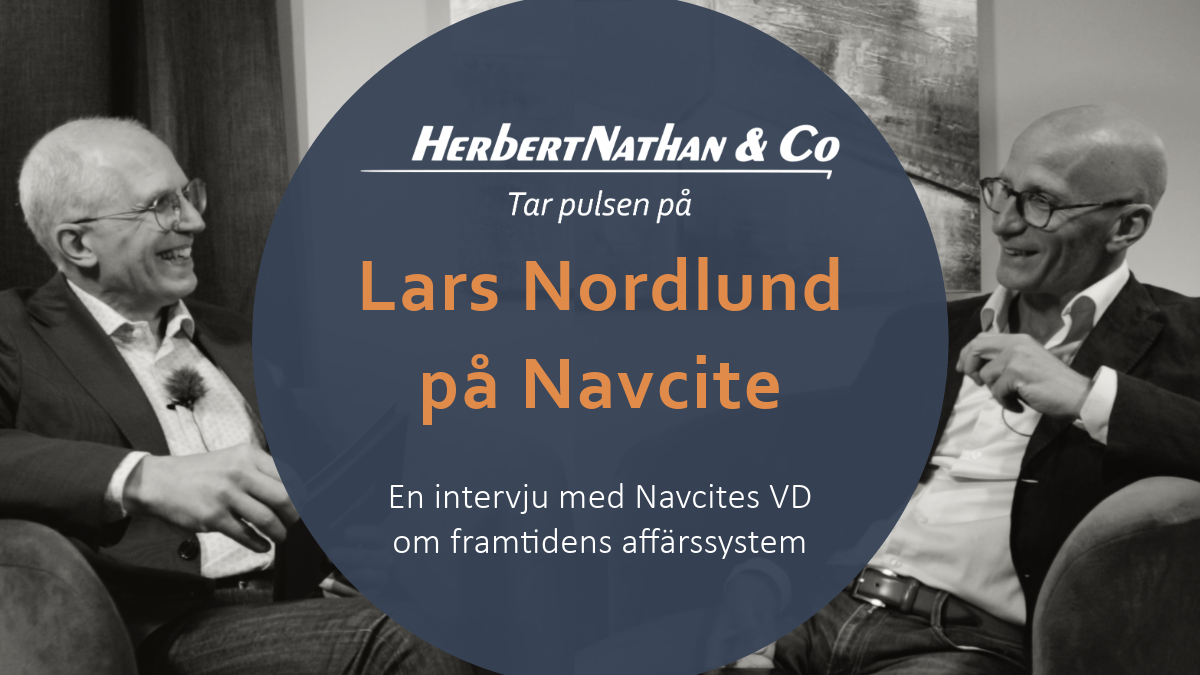
What if your ERP system could do more than simply show you what needs to be done – what if it could also help you get it done? AI is opening up new possibilities for how we work, but the real transformation is not just about technology. It is about the people who use it every day. In an interview with HerbertNathan & Co, our CEO Lars Nordlund shares his thoughts on the future of ERP systems, the opportunities created by AI and why the most important step is to start with the needs of the business.
ERP systems have long helped companies create structure, manage information and connect important business processes. But their role is now changing.
With AI and intelligent agents, these systems can do more than collect and present information. They can also help analyse situations, support better decisions and carry out tasks that previously required manual effort.
From Information to Action
Imagine a delivery is at risk of being delayed. Your ERP system can help you identify the problem, but someone often still needs to investigate the cause, check inventory levels and decide what needs to be done.
AI agents create opportunities to take this process a step further.
An AI agent can, for example, gather relevant information, identify potential causes and suggest actions. Unlike an AI assistant, which primarily answers questions and guides users, an agent can also use different tools to perform tasks.
Depending on how the solution is designed, the agent may also carry out certain actions independently, within clearly defined permissions and with the controls, traceability and approvals required by the process.
This is the development Lars describes in the interview. He talks about the shift from system of record to system of execution. From systems that primarily record information to systems that can also turn that information into action.
I believe AI agents will play a crucial role in the future. ERP systems will become increasingly autonomous and able to act on information, rather than simply manage it, Lars Nordlund, CEO of Navcite.
This does not mean removing people from the process. Quite the opposite. It is about freeing up time from manual tasks and giving employees better opportunities to focus on work where their experience and knowledge are needed.
Watch the Interview with Lars Nordlund
How will AI change the future of ERP systems? In an interview with HerbertNathan & Co, Navcite CEO Lars Nordlund discusses the opportunities of AI agents, developments in ERP and why business needs must always come first.
When Systems Start Working Together
One of the biggest opportunities with AI agents is that they do not have to be limited to a single ERP system.
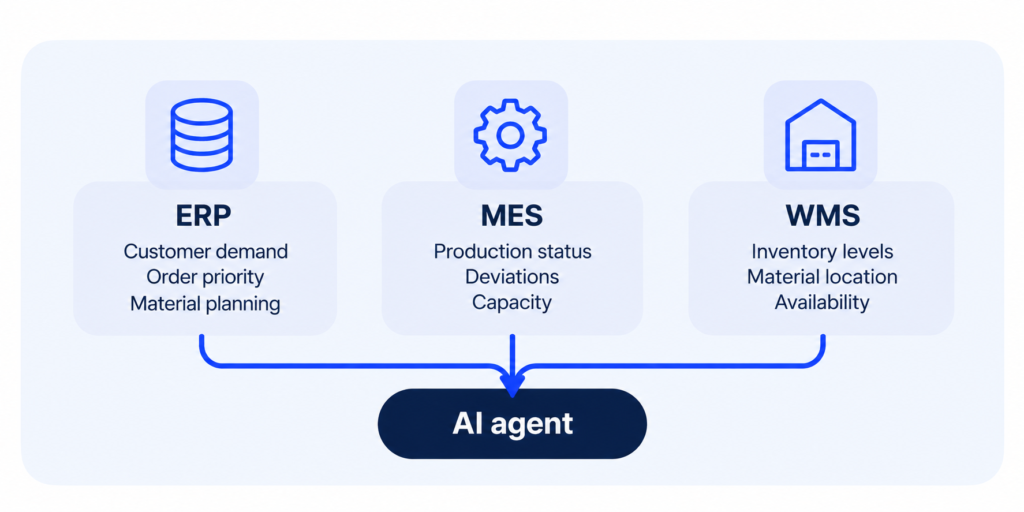
In many companies, important information is spread across ERP, MES, WMS and other applications. To understand what is happening and determine the right action, an AI agent needs to be able to combine information from multiple systems.
Imagine a production order is at risk of being delayed. The agent could retrieve customer requirements, order priorities and material planning data from ERP, current production status and the cause of the deviation from MES, and available materials and their warehouse locations from WMS. Based on this complete picture, the agent could assess the consequences and suggest actions, such as reprioritising a production order, moving materials or adjusting the delivery schedule.
The same principle can be applied to other areas of the business. AI agents can, for example, help review certificates, analyse production deviations or identify issues that need attention.
At Navcite, we have developed NAIS (Navcite Azure Integration Services), our own integration platform built on Microsoft Azure. The platform is used to connect ERP systems, applications and information flows.
By building on this foundation, AI agents can access information and functionality from multiple systems in real time. This creates opportunities for agents to work across system boundaries and become a natural part of existing business processes.Det handlar alltså inte om att ersätta alla system eller de AI-funktioner som redan finns. Det handlar om att få dem att samverka bättre.
It is therefore not about replacing all existing systems or the AI capabilities they already offer. It is about making them work better together.
The Opportunities Are There – But Where Do You Start?
Although AI is developing rapidly, it is not always obvious how companies should begin using the technology.
In the interview, Lars highlights the importance of concrete use cases. It is about demonstrating what the technology can actually do and how it can be used within existing business processes.
Which tasks take up a lot of time? Where do employees need to gather information manually? And which recurring tasks could be simplified?
By starting with these questions, it becomes easier to identify where AI can create real value.
It does not have to involve major changes from the beginning. An agent that saves a few minutes every day for many employees can create significant value over time.
At the same time, it is important to choose the right solution for the right task. Not every process needs an AI agent. Sometimes traditional automation is both simpler and more effective.
What matters is not how advanced the technology is, but which problem it solves.
AI Is Also Changing How ERP Systems Are Implemented
AI is not just about what an ERP system can do once it is in use. The technology can also influence how systems are implemented.
An ERP implementation often involves extensive work testing functionality, preparing data and training users.
Lars describes how AI can make parts of this work more efficient by, for example, generating test cases, creating test data and producing instructions.
AI can help us reduce the time required for many tasks. But ultimately, a successful implementation also depends on giving people the time to learn and become confident using the system, Lars Nordlund, CEO of Navcite.
It is an important reminder that technology is only one part of the transformation.
AI can contribute to more efficient implementations, but it does not replace the need for business understanding, training and change management. Users still need time to understand new processes and become confident in their ways of working.
The Future of ERP Starts with the Business
Both Infor and Microsoft are developing new AI capabilities for their ERP systems. In the interview, Lars describes how the vendors take somewhat different approaches, but also share significant similarities when it comes to AI agents.
For companies, it is therefore not just about which features are available in an individual system, but how the technology can be used together with other solutions across the business.
At Navcite, we combine our experience in ERP systems, integrations and business processes with the new opportunities created by AI.
Lars sees a future where ERP systems and AI agents play an increasingly active role in everyday work. But this development does not mean everything has to change at once.
It is about making the opportunities tangible. Showing how others have done it and how the technology can actually be used within your own business, Lars Nordlund, CEO of Navcite.
The important thing is to understand your processes, identify relevant use cases and start where the technology can make a difference.
Because the future of ERP is not just about what technology can do. It is about what we can do better with it.
Want to Explore How AI Can Create Opportunities for Your Business?
Contact Lars Nordlund at Navcite to discuss how AI can deliver tangible business value and improve your existing processes.

Lars Nordlund